March 4, 2006
TELCHAC PUEBLO AT DAWN
Early each Saturday morning, on my way to Hotel Reef, I walk into Telchac Pueblo about a mile west of the Hacienda. Until now I've arrived there well before sunrise, at about 6 AM. Days are growing longer, though, so now as I enter the sky is light enough to see the general shapes of trees and buildings.
The main street carries so little traffic -- maybe ten men on bicycles will pass me, and three or four vehicles -- that it's easier to walk in the street. Mostly the sidewalks are too narrow, irregular, and obstructed to be useful. Walking down the middle of the street at dawn one glimpses vignettes of small- town Maya life.
Someone has mounted corrugated tin roofing sheets on poles and set up an informal, wall-less restaurant beside his house. Even at this hour long, red ropes of pig flesh drape over poles beside a rickety, homemade table. Two or three campesinos sit hunched over the table, their straw hats shadowing their faces from the single naked lightbulb at the end of a wire dangling from the tin ceiling. I smell strong coffee, hot tortillas, and eggs sizzling in pig grease.
All around and from near and far roosters are crowing. Up in the trees Great-tailed Grackles screech, whistle, pop and rattle, and dogs bark on and on. Many houses, especially the small, one-room, cubical ones of cinderblocks the government provided to families who lost everything during 2002's Hurricane Isidor, stand in one another's shadows. One resident of such a house has his door open and his radio on full blare, providing salsa music to the whole block.
Passing by the market building near the center of town, people inside are busily sorting colorful heaps of bananas, oranges, pineapples, papaya, potatoes and chili peppers. Certain stalls sell coffee and sweetbreads. They also have their radios on, and a single lightbulb dangling from a naked wire from the ceiling. Everyone seems sleepy but in a good mood.
At the central plaza I pull myself atop a stone wall to wait with two or three others for Hotel Reef's little white bus that will carry us north. The stone wall is moist with dew and cold, but somehow it doesn't matter. Easy laughter drifts in from all sides and sometimes those powerful whiffs of coffee and hot tortillas float by. Great-tailed Grackles screech and rattle in the palm trees above us, and the palms become more than mere silhouettes against the bluing sky.
*****
JINGLES
On the beach I meet Barb and Steve Patrick from Calgary, Alberta. They're picking up a certain uncommon but not rare seashell that almost looks like large, silvery, flat fish-scales. The largest ones are about an inch and a half across.
"Barb arranges them in a small, shallow dish and barely covers them with water," Steve explains. "It's pretty to look at. When the light is right, you see rainbow effects, like mother-of-pearl."
Back in Hotel Reef's computer room it's not long before I have a name for the shells. They're called Jingle Shells, or just plain Jingles, and the animal they're from is ANOMIA SIMPLEX. Anomia is a bivalve so, instead of consisting of a foot beneath a single shell like a mollusk, its top and bottom shells clamp together. You can see a pretty assortment of Jingles at http://www.seashells.org/seashells/jingles.htm.
Jingles are distributed from Nova Scotia through the Caribbean and out to Bermuda. In water depths up to about 35 feet they attach themselves to any hard object in the water, even other shells, by means of threads extending through a hole in the lower shell. The upper shell (more correctly referred to as a valve) is more concave than the lower one
*****
YUCATAN ENDEMICS
The Yucatan is a geological PENINSULA, but it is an ecological ISLAND. It's isolated from other land toward the north, east and west by the sea, and to the south it's isolated from the rest of Mexico by this climatological fact: The Yucatan is much more arid than that part of Mexico adjoining it toward the south.
The Yucatan, then, is an ecological island and aridity, and Darwin's experiences in the Galapagos reminds us that on islands unique species tend to evolve. That's the case with the Yucatan.
When a biologist says that an organism is endemic to a certain area, he or she means that in the whole world that thing is found only in that limited area. A surprising number of organisms are endemic to the Yucatan.
Nearly 10% of the Yucatan's plant species are endemics. The Yucatan is home to 14 endemic cactus species, and here in the northern Yucatan -- the most arid part of the arid island -- we are home to ten of them.
Just among the sand dunes of Celestún along the Yucatan's western coast live three endemic plant species: a vine in the Milkweed Family, MATELEA YUCATANENSIS, and; two members of the Coffee Family, a bush, EXOSTEMA CARIBAEUM and an herb, SPERMACOCE CONFUSA.
Among animals, the Yucatan's reptiles and amphibians are particularly rich in endemics. At Celestún 15 endemic reptiles and amphibians have been identified.
At Río Lagartos on the northern coast, two fish species inhabiting freshwater pools are endemic: TYPHLIASINA PEARSEI and OPHISTHRNON INFERNALE.
For endemic birds, Cozumel Island off the Yucatan's eastern coast is especially notable because it is home to three species found nowhere else on Earth: the Cozumel Emerald (a hummingbird), the Cozumel Vireo and the Cozumel Thrasher.
One worrisome feature about all this is that currently a lot of land along the Yucatan's northern coast is being "developed," largely by English-speaking northerners building retirement homes. The first step in this process is to "clean away the scrub," which is precisely where so many of our endemic species live.
Theoretically regulations are in place to protect important species but from I see with my own eyes economic realities are allowing too much scrub to be "cleaned up."
*****
COCONUT PALM FLOWERS & FIBER
These mornings one of the favorite hangouts for orioles is in the flowering Coconut Palms. The brightly orange and black birds foraging among large clusters, or inflorescences, of yellow-green flowers, frequently resting and looking around from among the palm's dark green fronds, are pretty to see. I watch them as my campfire's white smoke lazily drifts skyward, and the orange flame next to me flickers with life.
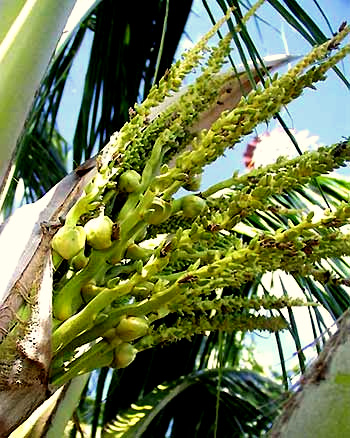
One day this week I decided to take a closer look at the flowers. I set a ladder against a palm's trunk and climbed it, taking along Vladimir's camera. You can see a foot-wide view of the inflorescence I visited at https://www.backyardnature.net/yucatan/cocoflrs.jpg.
Palms are "monoecious" -- their flowers are unisexual but flowers of both sexes occur on the same tree. In the picture, the many small, greenish items densely arranged along the slender, fingerlike things directed toward the upper, right corner (the rachillas), are male flowers, or what's left of them. Male flowers at their peak bear six pollen-producing stamens above three stiff, triangular scales representing the corolla. The much less numerous and larger, oval items at the rachillas' bases are female flowers, or the female flowers' pistils enlarging as they become coconuts.
Notice how the entire large inflorescence arises from a semi-woody, brownish, scooplike spathe. The spathe surrounds and protects the flowers as they develop before emerging from it. In the picture, the spathe base arises from the bottom, left and its tip reaches the top, right. Spathes remain on the tree until well after the fruits are mature.
Not all Coconut Palms are flowering right now. Some are full of green, enlarging coconuts and some bear old, brown ones.
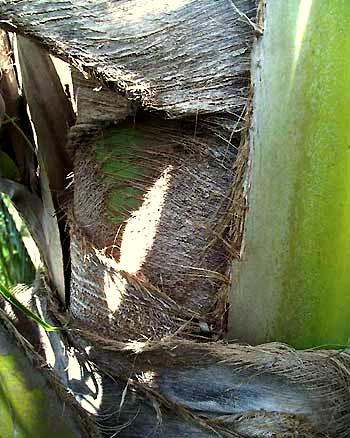
While up the tree I took a close look at the net-like, brown fiber arising from the bases of the tree's leaf stems, or petioles. The fiber material is so thick, tough and regular that it looks machine made. I also photographed this, and you can see it at https://www.backyardnature.net/yucatan/cocofibr.jpg.
In the picture, the broad green area at the right is the base of a frond's petiole. Notice how its fiber mat wraps around the palm's growing center or terminal bud area. You can imagine how this tough fiber protects the tender growing area from physical injury.
In the old days coconut fiber, called "coir," was famous for being employed for matting, mattress filling, cordage and the like. However, that fiber wasn't what's shown in the picture. The coconut fiber of commerce was derived from the coconut-fruit's husk. My musty old Hand Book of Tropical Plants by H.F. Macmillan proudly reports of coir "...27,250 Tons exported from Ceylon in 1933, valued at about 4s. 6d per cwt."
*****
BELTIAN BODIES & BULL'S-HORN ACACIA
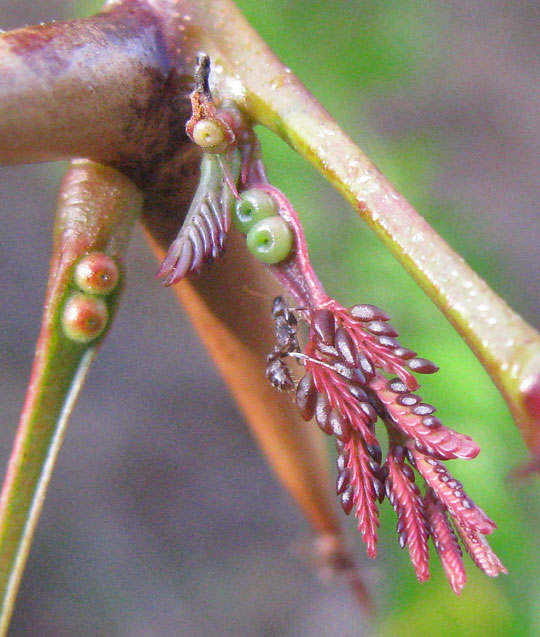
Bull's-horn Acacia, "Subin" in Maya, and ACACIA COLLINSII in Latin, is a common bush or tree here. This species provides a textbook example of mutualism. To see what I mean, take a look at my picture at https://www.backyardnature.net/yucatan/acaciabb.jpg.
That picture shows ants on one of the thorns. Those thorns are hollow and the ants live inside them, entering through ant-size holes near the thorns' tips. Notice those little green-apple-like things on the purple leaf petioles. Those are glands secreting sweet, energy-rich nectar the ants feed on. Finally, notice the yellow to yellow-orange items on some of the lower leaflets. These are Beltian bodies, which are protein-rich structures produced at the ends of some leaflets, and the ants eat them, too.
You can't see yet one more element of the mutualistic relationship between ant and tree. You learn about it fast, however, if you touch any part of the plant: Ants swarm over your hand, biting.
Finally, I've read that the ants clear away other plants from around the acacia, and that seemed to be the case with this particular plant.
So, acacia, ants and their tendency to bite, Beltian bodies, nectar glands, weed removal... All right there in front of me along a path I take every day, right on the hacienda grounds. I always show this to the tourists and they seem to agree with me that this is just about as impressive as anything else here.
*****
TREE COTTON
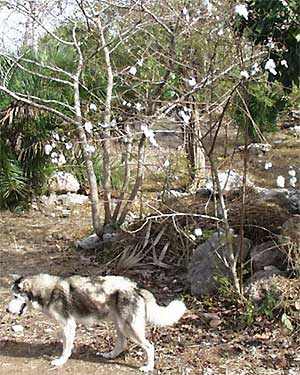
Cotton plants belong to the genus GOSSYPIUM of the Hibiscus Family. Over 20 Gossypium species exist, and there are many cultivated varieties. Cotton grown in the US is herbaceous and about knee high. Here we have a cotton species that grows as a woody, perennial bush -- Tree Cotton, probably GOSSYPIUM HIRSUTUM, despite its woody form.
The plant is about eight feet tall and currently is in its leafless, dry-season condition. However, new three-lobed leaves are just emerging from certain buds as the bolls are bursting with cotton.
You can see this plant, with the blue-eyed dog beneath it still wandering around looking for a home, at https://www.backyardnature.net/yucatan/treecott.jpg.
*****
PALM-NUT SPROUTING EXPERIMENTS
Vladimir and I think there's a possibility that before long the Gulf coast north of here is going to become something like a North American suburb, with just one little
"gringo retirement home" after another from one end of the peninsula to the other. We don't like this idea but don't see that there's much we can do about it.
One thing we are doing, however, is thinking about how we can help green up the coast once everything has been scalped by real estate speculators. We figure people will be wanting to buy ornamental plants, so regularly we walk around gathering seeds and sprouts for making experimental plantings. Maybe someday our seed-sprouting savvy will be useful.
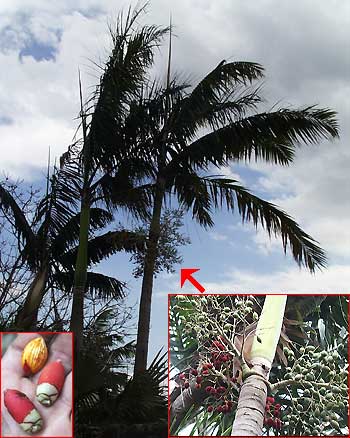
This week we gathered a bucketful of fruits from the Montgomery Palm, VEITCHIA MONTGOMERYANA, an endangered native of the island nation of Vanuatu in the South Pacific. You can see a picture of this palm with insets showing the large fruiting inflorescence curiously located midway up the trunk, and a close-up of three fruits, which are bright red at maturity, at https://www.backyardnature.net/yucatan/veitchia.jpg.
*****
SPAM-FILTER PROBLEMS
Sometimes a hundred or more of these Newsletters are returned because spam filters identify them as spam. Two weeks ago apparently not a single Newsletter was delivered. I expect this problem to grow worse as spam, spyware, viruses and such increasingly plague the Internet. Many spam filters can't distinguish my program-generated Newsletters from mass-produced spam. Filters used by AOL are especially bad.
Please remember that all past Newsletters, including this one, are archived at https://www.backyardnature.net/n/.
Eventually we may have to discontinue our subscription service altogether, and people wanting to read the Newsletter will just have to bookmark the above address and try to remember to go there each week.
*****
ON THE FIVE KINDS OF LOVE I KNOW
A naturalist caring about Life on Earth, -- even a sometimes-hermit one -- must be concerned with love. Before explaining why, let me tell you what I have learned about love during my 58 years.
The first love is the one between baby and parents. It is unconditional and instinctual, of a general nature all higher mammals are capable of.
A later-coming love is more community centered. It is based on the instinctual need for identity and status within a protective power structure. This love expresses itself through social syndromes such as patriotism and religion.
Romantic love is mostly a hypnotic state and therefore, though potentially intensely satisfying, ephemeral. Some might say that "sexual love" fits here, but from at least one perspective sex is but a physiological process that only sometimes, though maybe ideally, accompanies romantic love.
A fourth love is the one in our culture typical after romantic love has lost its hold. It is based on mutual respect as well as economic and social realities.
I personally have evolved only far enough to further list a love of a fifth kind. With an unclouded mind and an untroubled spirit one beholds the Universe's majesty and senses its order and the gorgeous manner by which it is evolving. One empathizes with the flow of things and recognizes that no matter how ugly and hurtful life may seem to an individual human the Universal Creative Force does things in a fundamentally beautiful and magnanimous manner.
In my opinion, a person's prime spiritual goal should be to experience this fifth kind of love -- and other kinds beyond it if they exist -- and to help others experience them, too.
Here is my reasoning: Life on Earth is endangered by human activity. It's clear that merely knowing what the problems are isn't enough. We humans are too vulnerable to self deception to be able to take action against an emergency of this scale and which is merely factual.
Only passion arising from the fifth kind of love can move us to the kind of self sacrifice and nobility needed to stop destroying Life on Earth.
*****
Best wishes to all Newsletter subscribers,
Jim