PLANTS | ANIMALS | ECOLOGY | FUNGI | GEOLOGY | GARDENING | TOOLS
MEXICAN PLANTS & ANIMALS HOME

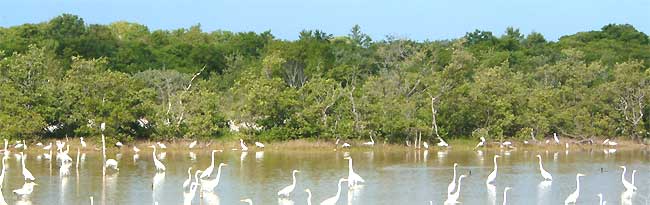
The word "mangroves" refers to a special community of plants and animals occurring in tropical areas that are inundated permanently or occasionally with saltwater. You find them intermittently along all the Yucatan's coasts and surrounding islands. Few ecosystems are as rich in species and shear numbers of living things, and are so important to the broader ecological community as mangroves.
However, mangroves are also very fragile. They are vulnerable to hurricanes, human drainage programs and "development." In many tropical countries mangroves are being destroyed to make way for hotels and beach-front homes.
THE YUCATAN'S FOUR MANGROVE SPECIES:
In the Yucatan Peninsula we think of four different species of shrubs or small trees as constituting our mangrove swamps. Often it's said that, in terms of water depth and salinity, the four species arrange themselves like this, with Red Mangrove on the left being in the deepest water, and Buttonwood on the right growing where often it's abovewater for long periods of time:
Here are the Yucatan's four mangrove species (click on names for more pictures and info about individual species):
Red Mangrove, Rhizophora mangle, of the Mangrove Family.
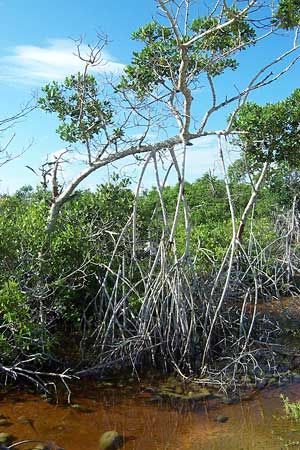
As the above picture shows, this species is easy to identify because the bottom part of its trunk branches profusely into numerous leafless "stilt roots" or "prop roots" which arch broadly in the air before entering water. Stilt roots provide the plant with stability in the loose mud and gather oxygen for underground parts. The airborne roots of one Red Mangrove intertwine with the next forming impenetrable thickets. Shellfish colonize the roots while fish and many other creature hide among them. The roots gather mud and build up the land. Red Mangrove is one of the most ecologically important woody plants along the Yucatan's coast. Red Mangrove's leaves grow up to 5 inches long, and the tree can grow up to 80 feeet tall in Mexico's tropics, though usually they are much smaller.
Black Mangrove, Avicennia germinans, nowadays usually placed in the Acanthus Family.
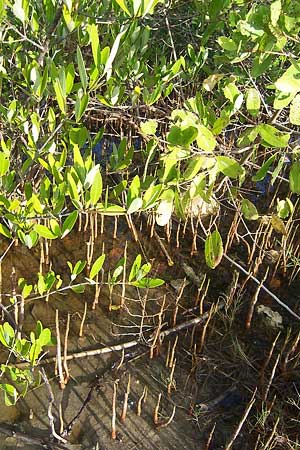
Black Mangrove is easy to identify because from its widely spreading, belowground roots hundreds of slender, gray-brown, pencil-like items emerge vertically from the mud to about a foot high -- as shown at the above. These are called pneumatophores and they collect oxygen for the submerged roots. Black Mangrove grows higher above the low-tide mark than Red and White Mangroves, so you often see Black Mangrove pneumatophores emerging from mud, not water. Black Mangrove's leaves are only about three 3 inches long, and are hairy below. The 4-lobed flowers are white and up to half an inch long. The fruit is a compressed, 2-valved, 1-seeded capsule up to about 1.5 inches long and an inch wide. Here in the tropics Black Mangrove can grow up to 70 feet tall, though usually on the northern coast it's only ten to fifteen feet high.
White Mangrove, Laguncularia racemosa, also of the Combretum Family
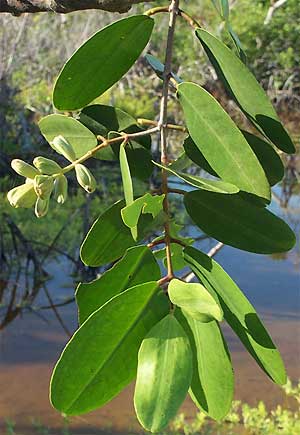
White Mangrove produces half-inch-long, reddish brown, 10-ribbed, leather, cigar-stump-shaped fruits. The ones on the left side of the above picture are immature and therefore still green. White Mangrove's leaves, which are up to 3 inches long, have rounded or notched tips. Notice the leaves' rather long, roundish petioles, which usually are red, jutting from the stem almost at right angles. Also maybe you can see at the top of the petioles -- especially of the top leaves in the photo -- "bumps," which are glands that help the plant rid itself of excess salt. White Mangrove may grow up to 60 feet tall in Mexico's tropical regions.
Buttonwood or Button-mangrove, Conocarpus erecta, of the Combretum Family
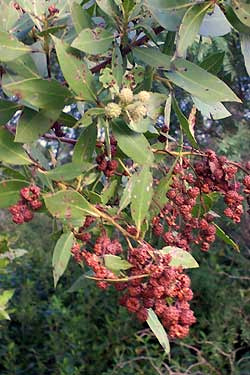
Buttonwood lives even higher above the low-tide mark, often on seldom inundated, not-too-salty ground. Unlike the three other species considered to be mangroves, Buttonwood often bears clusters of small, cone-like fruits, and its stems have alternate leaves -- only one leaf arising at each leaf-producing place along the stem. The leaes are are pointed and grow up to 4 inches long. As its picture at the right shows, its fruit clusters consists of spherical, brown, pea-sized, conelike heads. Under ideal conditions Buttonwood can grow to 60 feet tall, though usually it is considerably lower. Buttonwood is tough and flexible, which is good because at its position on the outer margin of the mangrove ecosystem it needs to absorbe the wind and storm surge accompanying tropical storms and hurricanes.
MANGROVES ANCHOR THE SOIL
Mangroves occupy an exceptionally vulnerable part of the coastal ecosystem: That part of the land between the low tide and high tide marks. Most of the time this land quietly bakes and simmers beneath the tropical sun, but when storms come -- especially hurricanes
-- mangrove species hold the land together.
Without them the storm surge would reach far deeper inland. Without them, barrier islands might be completely scoured away.
They also maintain water quality and clarity, filter pollutants and build the land by trapping sediment that otherwise might wash into the sea.
MANGROVES PROTECT WILDLIFE
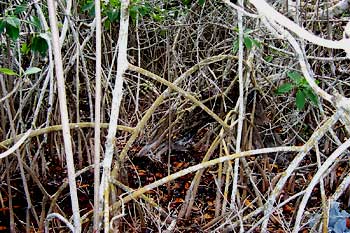
The mangroves' tangle of roots -- such as the typical, fairly impenetrable tangle of Red Mangrove aerial roots shown above -- provide protected nursery areas for shrimp and other crustaceans, mollusks, and fishes. Thus they are critical for the commercial and recreational fishing industries. Huge numbers of migratory birds occupy the mangroves.
The Yucatan's mangroves often provide safe sites for breeding colonies of such wading birds as egrets, herons. Also they are home to such interesting species as Clapper Rail, Rufous-necked Wood-rail, Mangrove Cuckoo, the kingfishers, and Mangrove Warbler.
from the July 24, 2011 Newsletter issued from Mayan Beach Garden Inn 20 kms north of Mahahual; Caribbean coastal beach and mangroves, ~N18.89°, ~W87.64°, Quintana Roo state, MÉXICO
MANGROVES SLOWLY FILLING WITH WATER
With the rainy season's gradual arrival, slowly large parts of mangrove swamps that until now have been dry are slowly filling with water. You can see a tangle of head-high Red Mangrove, Rhizophora mangle, that a month ago stood upon dry, caked mud below:
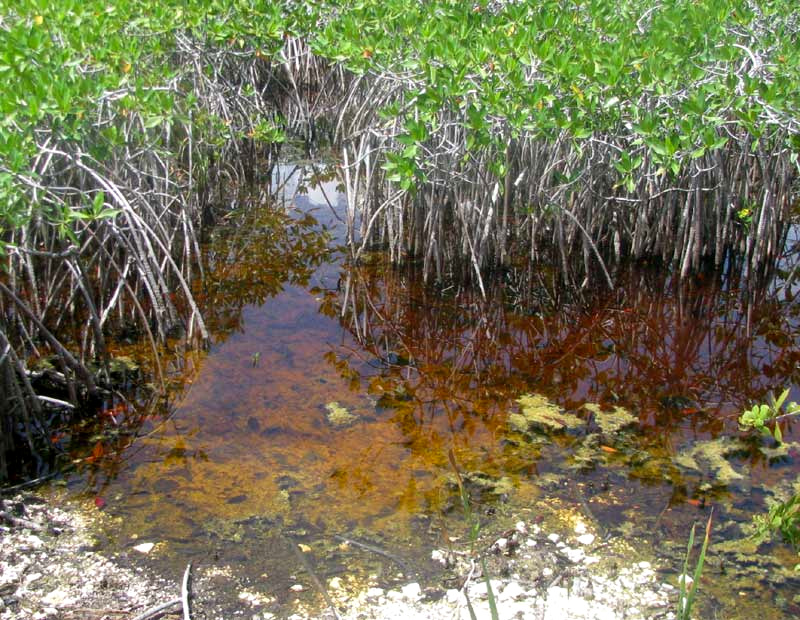
After a good rain the water rises higher, as you'd expect. However, if you really pay attention over a period of time, gradually the feeling grows that sometimes the water's average depth increases faster than the rains would seem responsible for. Also, if several dry days come along, the water may stand longer than seems reasonable. The impression is that something in addition to local rains is contributing to the mangroves' water-level rise.
Many studies show that that's the case. Remember that the Yucatán Peninsula is a vast slab of limestone eaten through and through with caves which, if occurring below the water level, carry underground rivers. In the northern and central peninsula, there are no surface rivers or streams. During the rainy season, rainwater quickly seeps underground along fractures in the limestone, into sinkholes and caverns, and merges with the water table.
The Yucatán's subterranean streams flow outward toward the nearest sea. Since the peninsula pokes northward into the zone of aridness at ±30°N (which we've considered here) in the Yucatán it's much rainier in the south than in the north. Thus the general flow of freshwater in the Yucatán's underground rivers is both from south to north, as well as outward toward the coasts.
In short, those big storms I've been mentioning that most afternoons form inland but usually stay away from us on the coast, plus the even larger, more intense storms forming farther south, especially in Guatemala, are contributing to the increasing water level in our mangroves. In our mangrove picture you can see that the water is reddish. I'm guessing that the redness is tannic acid leached from Red Mangrove leaves decomposing in the mud, through which much of the standing water has filtered upwardly after its long subterranean journey up from Guatemala.
By the way, the freshwater seeping into the mangroves nowadays creates a thin lens floating atop deeper saltwater. When the rainy season ends, not only will the mangroves' water level drop, but also saltwater will intrude into places where previously there was freshwater -- as in certain wells of homes here along the coast.
The freshwater/saltwater interaction is complex and sometimes unpredictable. You might enjoy looking over the paper "Freshwater Resources in the Yucatan Peninsula" freely available online, at https://www.nap.edu/read/11875/chapter/3.
from the October 23, 2011 Newsletter issued from Mayan Beach Garden Inn 20 kms north of Mahahual; Caribbean coastal beach and mangroves, ~N18.89°, ~W87.64°, Quintana Roo state, MÉXICO
MANGROVE WATER SEEPING INTO THE OCEAN
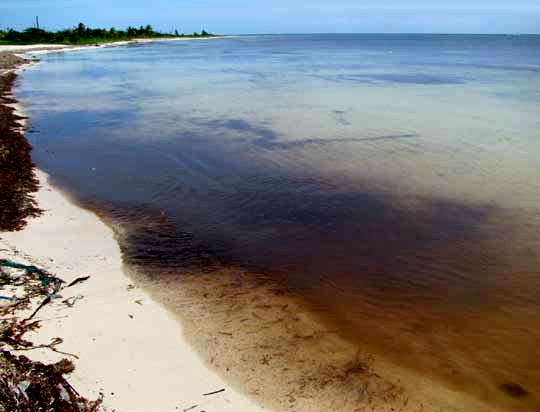
Above you see the beach here one afternoon this week at low tide something orange-brown seeped from the sand into the ocean's clear water. Apparently it was mangrove water, which is this color nowadays because of its high levels of tannic acid deriving from decaying mangrove stems and leaves.
If it is indeed mangrove water, it's flowing beneath the entire low sand ridge separating the sea from the mangroves. At this seeping-out location, the ridge is maybe 1000 feet across (300m). Several such seeps occur along the beach, but I've noticed them only lately. That makes sense because earlier the water level in the mangroves was lower. Now it's high, and when low tide occurs the mangrove's water level is higher than the sea, so naturally mangrove water would seek release in the ocean.
Marcia tells me that a bit offshore she's seen such stained water gushing up six inches or so above surrounding seawater, so apparently sometimes there are subterranean channels with vigorous flow. That would be less unexpected if we were on limestone where underground rivers often flow in caverns, but here we're on pure sand.
from the December 28, 2014 Newsletter issued from Río Lagartos, on the Yucatan Peninsula's northern coast (~N21.60°, ~W88.16°), Yucatán state, MÉXICO
ESTUARY WATER ENTERING THE SEA
In front of Río Lagartos, directly north of town across Ría Lagartos Estuary, a manmade canal cuts through the narrow finger of land separating the estuary from the Gulf of Mexico. At one edge of the canal's seaward outlet there's a seawall topped with a Jesus-on-the-Cross fisherman's chapel lighted at nights with solar power stored in a battery, as shown below:
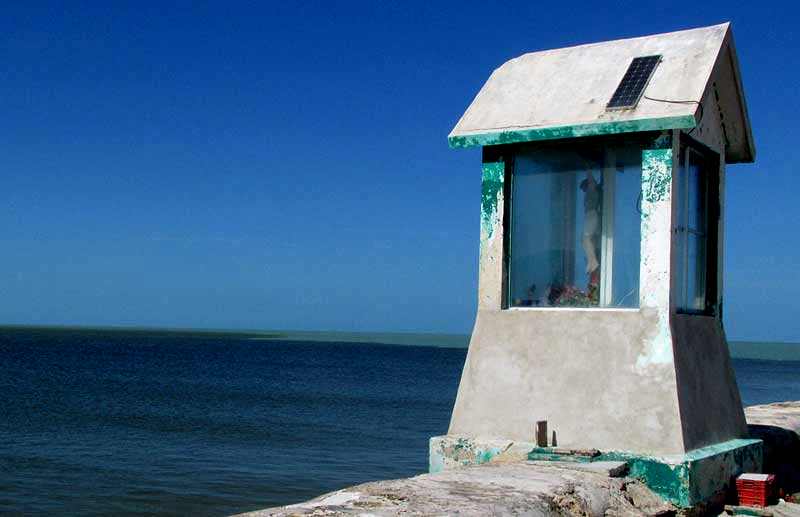
Beyond the chapel, notice how the Gulf's water changes color. The dark blue water on the left is issuing from the estuary during ebb tide -- when the water is going down.
The water's darkness is caused by orangish tannin pigments derived from decomposing organic matter in the mangrove area, and from organic matter itself suspended in the water. Mangrove trees are especially rich in tannins.
These tannin- and organic-matter-rich waters are profoundly important to offshore biological communities, especially the corals. As Lucaya Luckey-Bethany writes in the paper "Mangrove Forest Decline and its Effect on Coral Reefs," "The destruction of mangrove forests in the coastal wetlands is drastically decreasing the amount of natural tannins in the water and thus subjecting the nearby coral reefs to undue UV radiation. In effect, the reefs are being sunburned and eventually coral bleaching occurs."
Therefore, when fishermen exit the canal on their way to unknown fortunes on the high sea, they may tip their hats to Jesus on his Cross in his solar powered chapel, but it would also be appropriate to show their respect for the dark water below them, which assures the productivity of the fisheries they're going out to exploit.
Its water dark with organic matter and tannins -- not to mention zooplankton, phytoplankton and immature organisms that have used the mangroves as a nursery -- is the very lifeblood of the offshore ecosystems they depend on.